
How to Set a Table (Without Overthinking It)
I still remember an old Gilligan’s Island episode where the Howells were trying to determine whether a Tarzan-like stranger had gone to Harvard or Princeton. Mrs. Howell confidently explained that if he picked up his fork with one hand, he was clearly a Princeton man. If he picked it up with the other, he must have gone to Harvard. When he ignored the silverware altogether and simply ate with his hands, Mr. Howell threw up his hands and exclaimed, “Egads! A Yale man!”

As someone who actually graduated from Yale, I’ve laughed at that joke for years. The funny thing is that the older I get, the more I think the joke accidentally made a good point. We spend an awful lot of time worrying about where a fork belongs and not nearly enough time thinking about why we set the table in the first place.
If you spend five minutes scrolling through Pinterest, you’ll find tables that look like they belong in the pages of a magazine. Charger plates. Bread plates. Butter knives. Three different wine glasses. Napkins folded into elaborate shapes that almost seem too beautiful to unfold. I have to admit, I love looking at those tables. I even photograph my own ceramics in settings like that because they inspire people. They make us imagine inviting friends over, lingering over dinner, and creating memories around the table.
But if I’m being honest, they don’t look much like the table I grew up around.
I was raised in the Peterstown section of Elizabeth, New Jersey, in a big Italian-American family where dinner wasn’t about impressing anyone. It was simply what we did every evening. Everyone gathered around the table, the television stayed off, and the conversation was almost as important as the food.
Our place settings were about as uncomplicated as they could be. We used a fork and a knife for just about every meal, and a spoon only when the meal actually called for one. Despite eating plenty of pasta, we never twirled spaghetti with a spoon the way you often see in restaurants today. If the pasta needed a little help, we used the side of the plate and somehow managed to eat just fine.
We drank from tumblers instead of wine glasses. There wasn’t a bread plate sitting beside the dinner plate, and I don’t remember a butter dish making many appearances either. Honestly, what would have been the point? Around our house, bread had a much more important purpose than sitting by itself on a tiny plate. It was there to soak up the last bit of tomato sauce, the olive oil left behind after the salad, or the juices from whatever roast my mother had made that evening. Bread wasn’t a side dish. It was often the final course.
It wasn’t until I was much older that I realized there were entire books devoted to the “proper” way to set a table. Somewhere along the way, though, I also discovered that I genuinely enjoy creating beautiful tables. Not because they’re formal, but because they tell your guests something before anyone has taken a seat. They quietly say, I was looking forward to having you here.
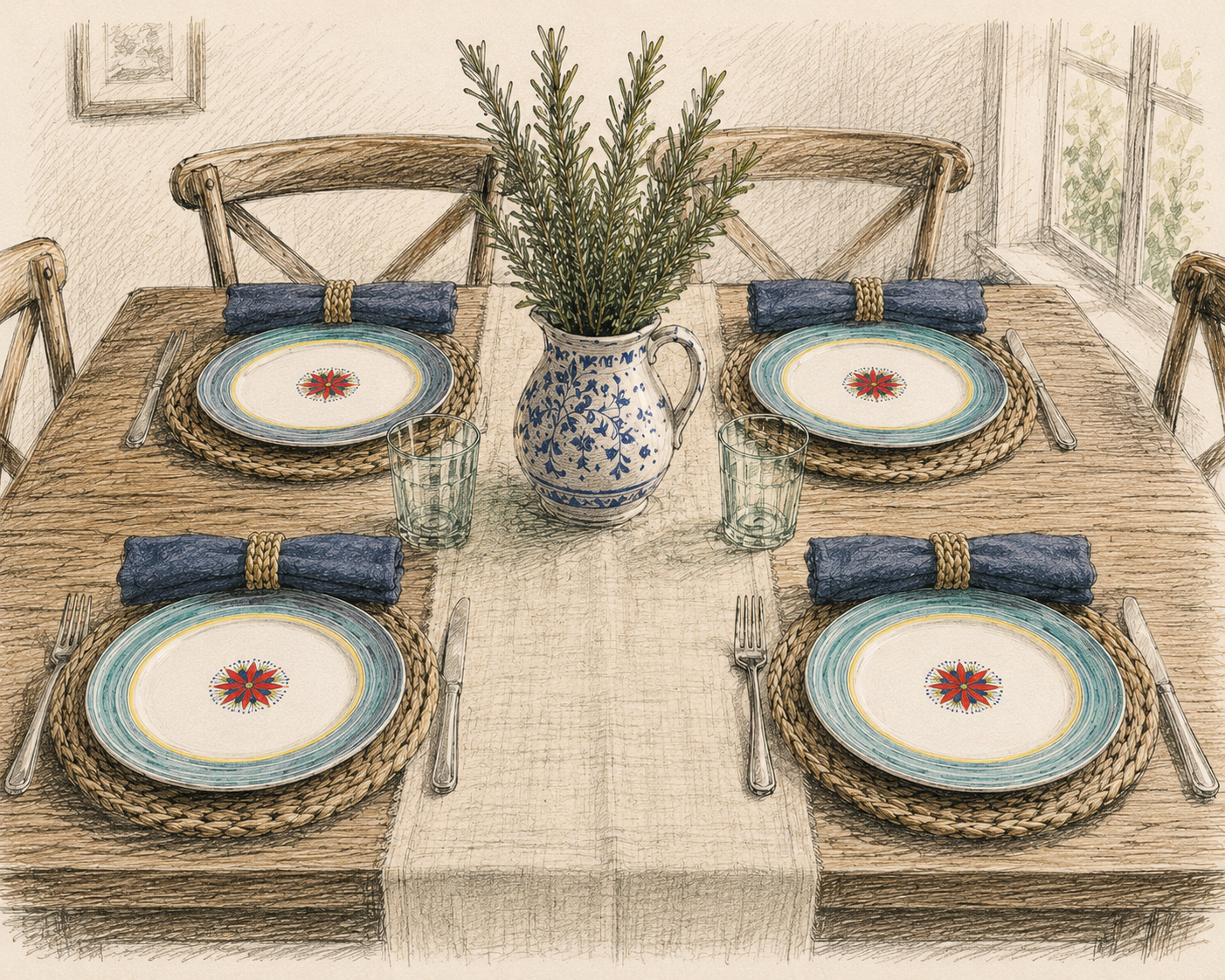
Today, when I’m setting the table for family or friends, I still keep things fairly simple. I almost always start with a natural linen runner because I like seeing the warmth and character of the wood table beneath it. Depending on the occasion, I’ll add linen placemats to give each place setting a little more definition, but I don’t feel the need to layer five different pieces of china or cover every inch of the table.
One thing I do enjoy is adding contrast. If the runner is a natural linen color, I’ll often use deep blue linen napkins to complement the tableware without making everything feel too matched. I don’t fold them into elaborate fans or swans. A simple napkin ring is all they need, and I usually place the napkin just above the dinner plate. It looks elegant, it’s practical, and your guests don’t feel like they’re undoing twenty minutes of work just to sit down.
The centerpiece is usually just as simple. I love filling a ceramic pitcher with fresh rosemary from the garden. That’s it. The rosemary doesn’t need to be woven through the runner or tucked under every plate. One arrangement in the middle of the table adds color, fills the room with a wonderful aroma, and reminds me of the Mediterranean without feeling forced.
People sometimes assume that because I spend my days surrounded by handcrafted Italian ceramics, every meal in our house must look like a magazine photo shoot. The truth is, most of our dinners are still pretty ordinary. We aren’t lighting a dozen candles on a Wednesday night or polishing crystal stemware before serving pasta. What I have learned, though, is that a beautiful plate has a way of making an ordinary meal feel just a little more special. Leftover pasta somehow tastes better when it’s served on a plate that was painted by an artisan in Deruta instead of something pulled from the back of a kitchen cabinet.
That’s one of the things I’ve always admired about Italy. Everyday meals are treated with a certain amount of respect. Not because anyone is trying to impress their guests, but because sharing a meal is worth slowing down for. Beautiful tableware isn’t reserved for holidays. It’s simply part of daily life.
I suppose that’s really the philosophy behind Tavola Piena. I’ve never wanted to sell dishes that spend 364 days a year sitting behind glass in a china cabinet. I’d much rather see them holding a bowl of spaghetti on a Tuesday evening while family and friends argue over whose turn it is to do the dishes. To me, handcrafted ceramics become meaningful because they’re used, because they become part of birthdays, anniversaries, Sunday dinners, and all the ordinary evenings in between.
So when people ask me how to set a table, my answer is probably not what they expect. Yes, I appreciate a beautiful runner, a stack of linen napkins, and a thoughtfully arranged centerpiece. I enjoy mixing textures and adding just enough color to make the table feel inviting. But I don’t worry very much about whether every piece of silverware is positioned exactly according to an etiquette book.
What matters is that your guests feel comfortable enough to relax, pour another glass of wine—or sparkling water in one of those familiar tumblers—and stay for another conversation.
Looking back, I think the Gilligan’s Island joke had it all wrong. The important question isn’t whether someone knows which fork to use. It’s whether they’re the kind of person who makes everyone else at the table feel welcome.
Because years from now, nobody is going to remember whether your napkin was folded perfectly or whether your water glass was exactly where Emily Post said it belonged. They’ll remember the stories that were told, the laughter that echoed around the table, the second helping of pasta, and the last piece of bread that disappeared into the sauce.
If your guests leave wishing dinner had lasted just a little longer, you’ve set the table exactly the way it was meant to be.