
What “Hand-Painted” Actually Means (And Why Prices Vary)
If you’ve ever browsed Italian ceramics and wondered why two similar-looking pitchers have wildly different price tags, you aren't alone. Both are labeled “hand-painted.” Both come from historic workshops. So, what gives?
It usually comes down to a distinction that isn't always explained on the label: the difference between guided work and freehand work.
In many of the traditional workshops, decoration starts with "the guide." This might be a stencil or a light charcoal tracing that lays out the geometry of the pattern. From there, the artisan takes over, hand-painting every leaf, vine, and scroll. It requires an incredible amount of discipline and a steady hand. The beauty of this method is the consistency—if you’re looking for a dinnerware set that feels cohesive and balanced, this is exactly what you want.
At Tavola Piena, we love these pieces. They allow us to offer authentic, artisanal work at a price point that makes sense for an everyday table. It’s still hand-painted, it’s still Italian, and it still carries the soul of the maker—it’s just a more controlled process.
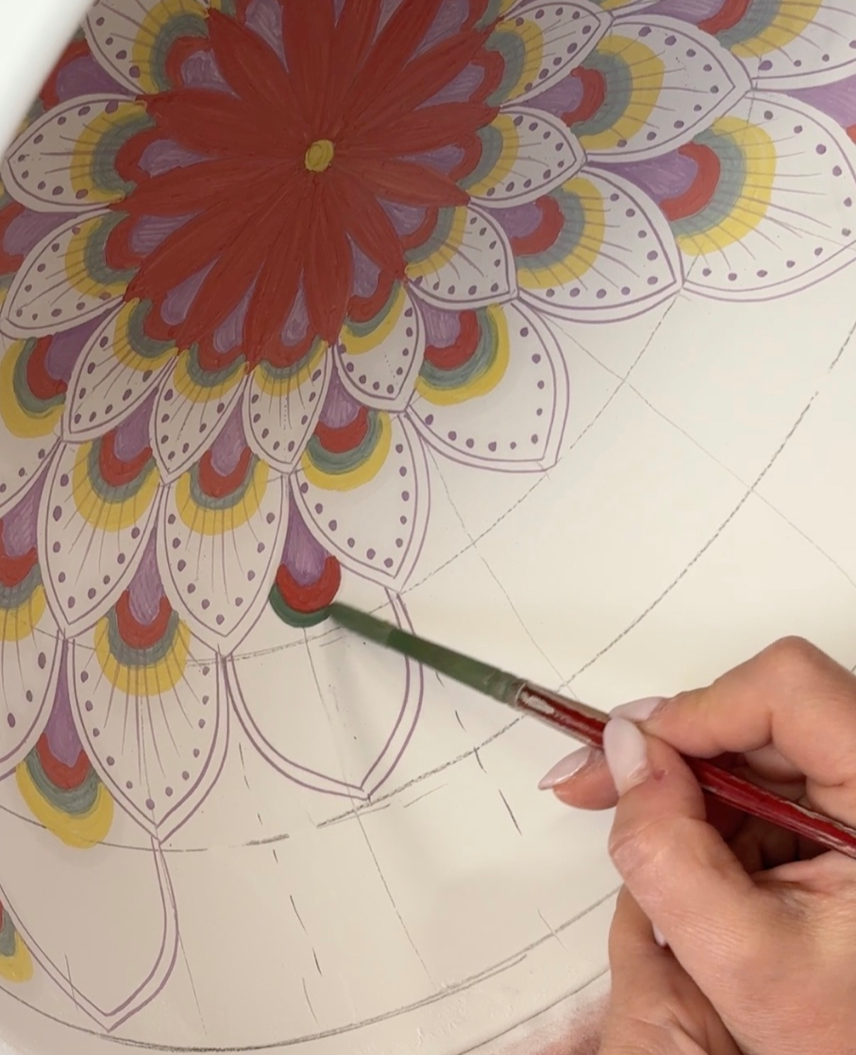
Then, there is true freehand painting.
This is a different level of intensity. When an artisan works freehand, they aren't following a pre-drawn line. They are building the composition stroke-by-stroke, making real-time decisions about the curve of a stem or the weight of a border. You can see it when you look closely: the lines "breathe" a little more. There’s a certain movement in the pattern that you just can't get from a template.
Why the higher price? Because freehand work is a high-wire act. There is no safety net. It takes longer, demands more expertise, and ensures that your piece is truly one-of-one. You aren’t just paying for the paint; you’re paying for the artisan’s ability to "see" the design on a blank surface and execute it perfectly without a map.
We make a point to carry both styles for a reason. We believe everyone should be able to bring a piece of Italian artistry into their home, whether that’s a beautifully consistent "guided" piece for daily use or a freehand masterpiece that serves as the crown jewel of your collection.
Both are handmade. Both are traditional. But once you understand the "why" behind the price tag, you can choose the piece that tells the right story for your home.