
How we curate a collection
People often assume that creating a new collection begins with designing something entirely original. In reality, my process usually starts with the exact opposite approach.
I begin by studying traditional Italian ceramics, particularly the historic designs that have made Deruta famous for centuries. There is a reason many of these patterns have endured for generations. The artistry is extraordinary. The balance, the color, the movement, and the hand-painted detail reflect a level of craftsmanship that is increasingly rare in today’s world. Instead of simply looking for beautiful designs—which are abundant—the real challenge lies in deciding how to reinterpret them for today’s table.
Traditional Deruta ceramics were often created in an era when decoration was celebrated differently than it is today. Rich borders, intricate flourishes, elaborate geometric motifs, and layers of ornamentation all had their place. Those pieces remain beautiful, and I continue to admire them, but many people furnishing a home today are looking for something that feels a bit more approachable. They want authenticity and craftsmanship, but they also want tableware that feels comfortable enough for a Tuesday night dinner, not just a special occasion.
Finding the Essence of the Design
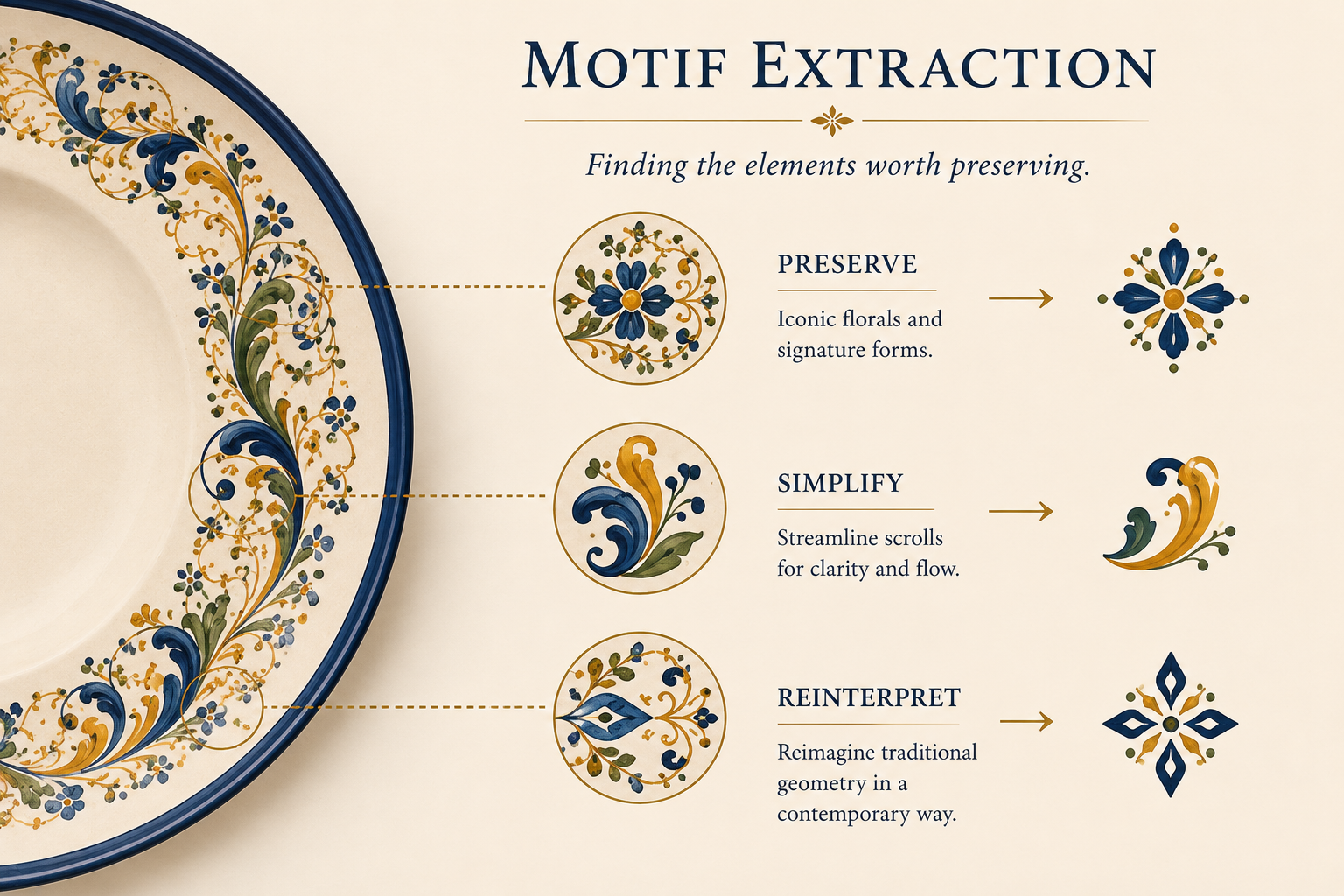
This is exactly where my curation process begins. Sometimes I look at a classic Deruta pattern and ask myself what would happen if I stripped away some of the complexity and allowed the strongest elements to stand on their own. Other times, I might find inspiration in a particular motif or border and reimagine it completely. Rather than copying a historic design, my goal is to understand what made it beautiful in the first place and build upon that foundation.
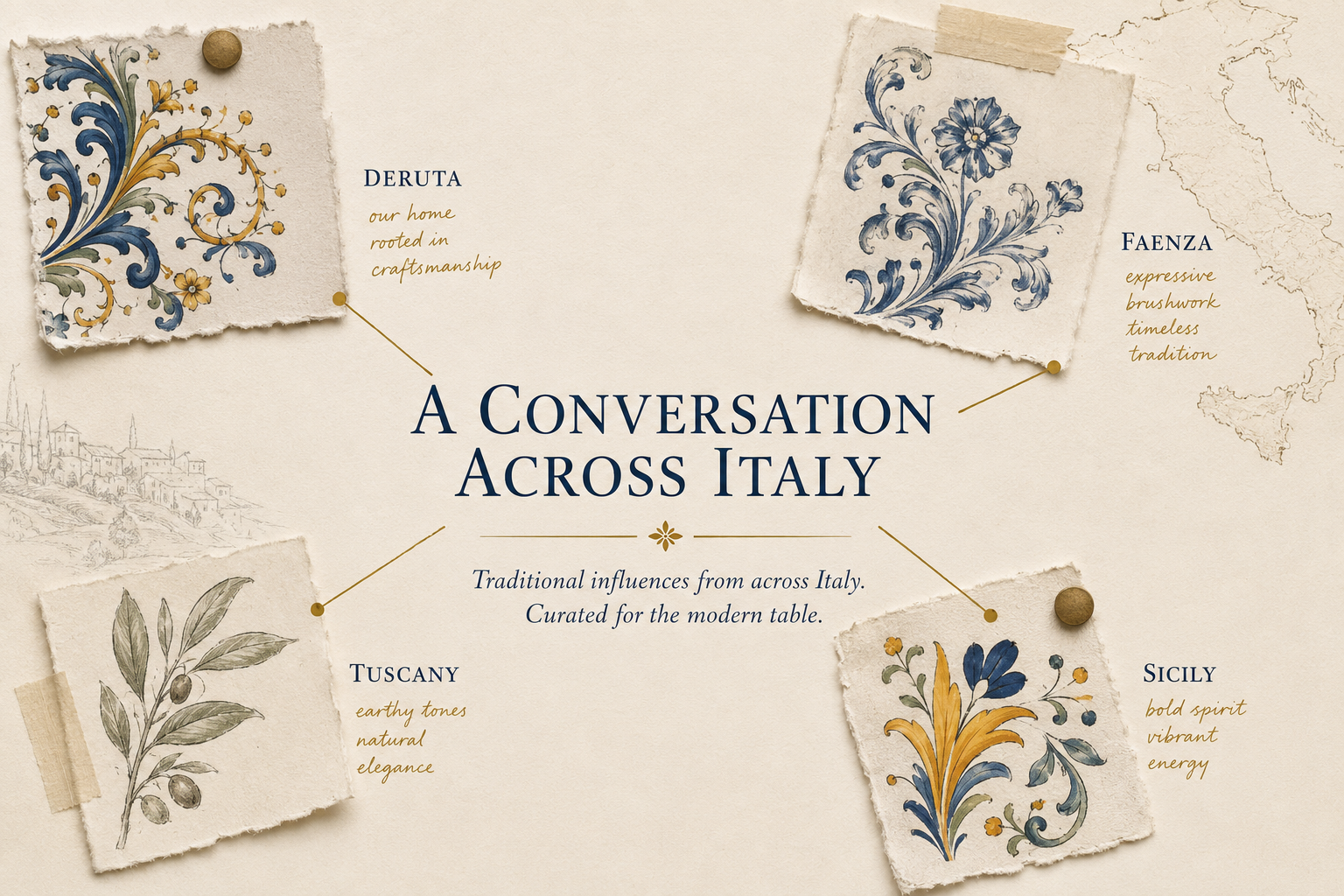
I am also not limited to a single region of Italy. While Deruta remains at the heart of what we do, Italy’s artistic traditions are remarkably diverse. There are times when I find myself drawn to details from other regions, like the flowing movement of Sicilian scrollwork. The energy of those decorative elements brings a very different character to a design while still feeling authentically Italian. Bringing together influences from different regions allows me to create pieces that honor tradition without feeling bound by it.
As a collection begins to take shape, I think about the place setting as a whole rather than focusing on any individual piece. One of the most common mistakes I see is treating every item as though it needs to carry the full weight of the design. Historically, that was often the case; chargers, dinner plates, bowls, and salad plates might all feature the exact same level of dense, hand-painted detail.
The "Canvas and Focal Point" Strategy
I take a different approach.
The larger pieces often provide the canvas. By leaving portions of those pieces undecorated—or by reducing the amount of color and intricate hand painting—I can create a design that feels lighter and more contemporary, which also reduces the amount of labor required to produce it. This simplicity is intentional. It gives the eye a place to rest and allows the table to feel elegant rather than overwhelming.
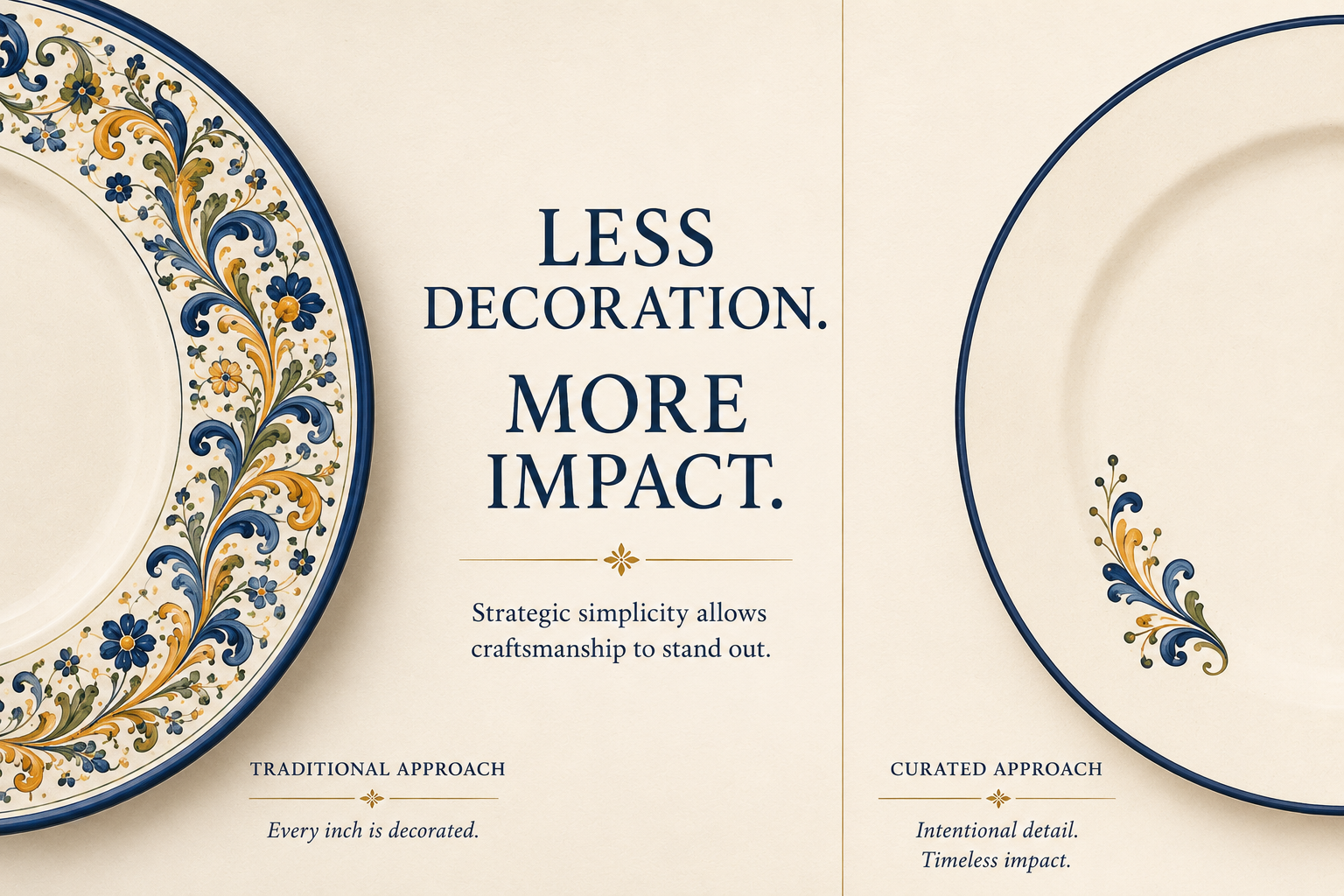
However, this doesn’t mean eliminating detail entirely; instead, it is about concentrating the artistry where it has the greatest impact. In many of my collections, the most intricate artwork is reserved for the smaller pieces, particularly the salad plate. When a table is fully set, the salad plate naturally becomes the visual focal point. It sits at the top of the stack and provides that beautiful moment of discovery when guests take their seats.
You can see this philosophy directly applied in our newest releases:
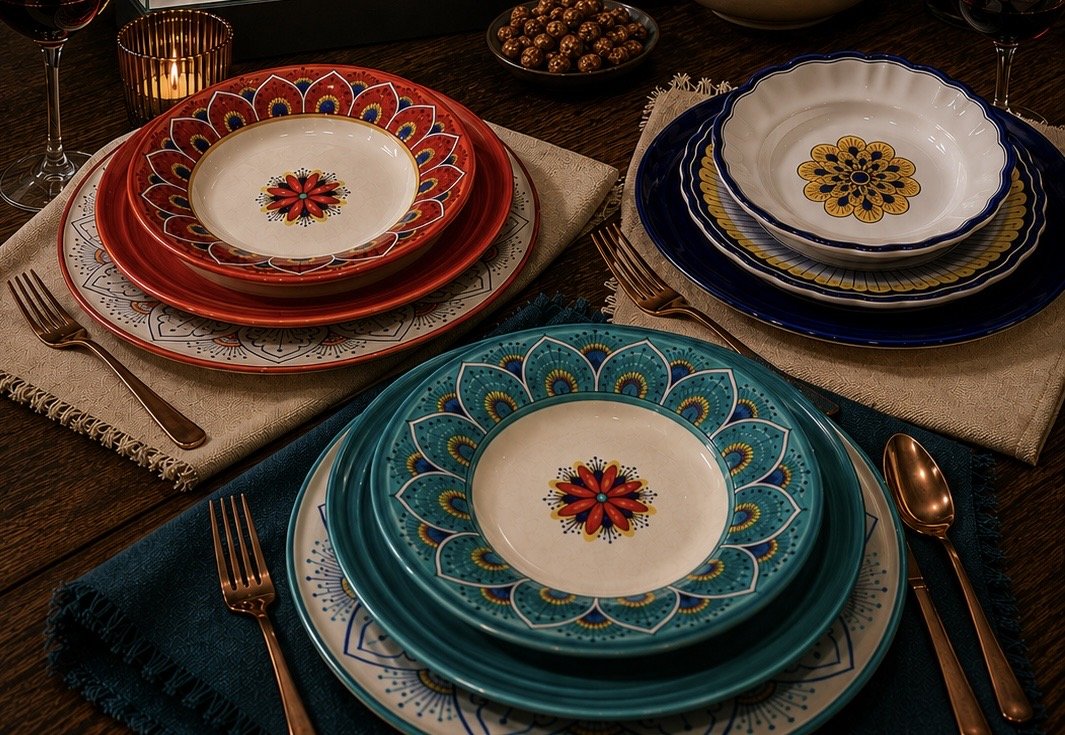
The Classic Cobalt & Yellow: The traditional Deruta DNA is unmistakable here, drawing on historic palmette motifs and ornate central rosettes. But instead of repeating that dense pattern everywhere, I layered it. The charger acts as a bold, solid blue anchor. The dinner plate strips away heavy ornamentation, using a simple, rhythmic striped border to provide structure. The bowl introduces the intricate central motif but leaves the walls as clean, unpainted space. Finally, the salad plate receives the full, complex geometric pattern, making it the undeniable star.
The Red Mandala: In this collection, I played with the hierarchy differently. The salad plate is deeply saturated with an intricate, layered petal mandala. Beneath it, the dinner plate removes the pattern almost entirely, relying instead on a beautiful, solid red glaze with just a whisper of a contrasting rim. To frame it perfectly, the charger introduces a delicate blue-and-white line-art variation of the motif.
Tradition for the Modern Table
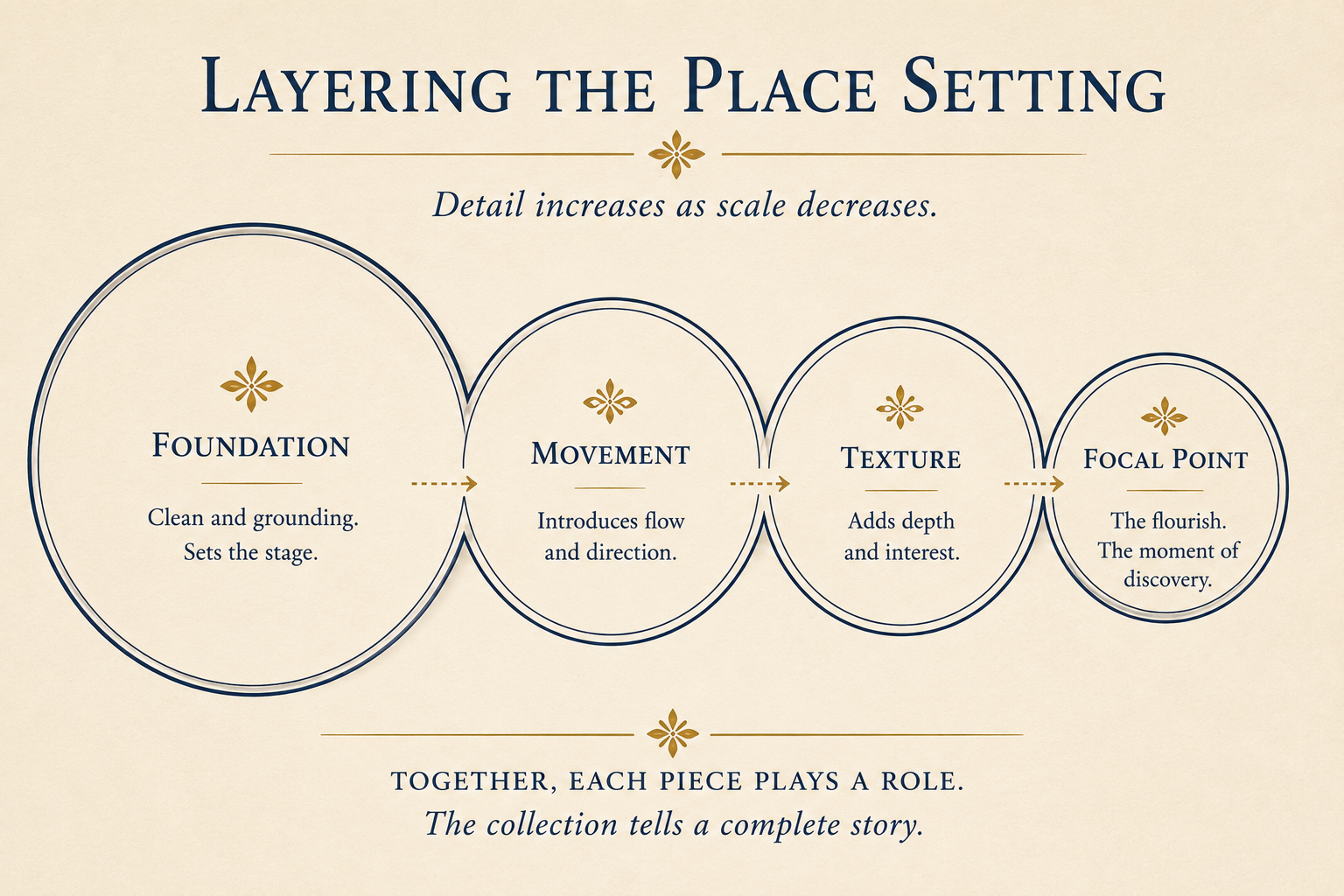
The result of this careful layering is a cohesive design that feels deeply intentional. The charger establishes the foundation. The dinner plate introduces movement. The bowl adds another dimension. The salad plate delivers the flourish. Together, they create a place setting that feels rich and complete without requiring every square inch to be decorated.
This approach has another practical benefit: by concentrating the most labor-intensive hand-painted details where they create the greatest visual impact, we can often make a collection more attainable without sacrificing quality. We are not moving production to lower-cost factories, using inferior materials, or asking artisans to lower their standards. We continue to work with some of the most respected studios in Deruta because the quality of the craftsmanship is non-negotiable. It is only the design itself that changes.
The result is tableware rooted in centuries of Italian ceramic tradition that feels perfectly at home in a modern setting. They are pieces that can be deeply appreciated for their artistry, but more importantly, they are meant to be used.
After all, we aren't creating ceramics meant to spend their lives behind glass. Ultimately, the goal is to design museum-quality tableware that earns its place at the center of your table—surrounded by family, friends, food, and lively conversation. That is where these pieces truly come to life.